TEACHING + TALKS
The natural brilliance of outsiders.
For thirty-seven years, Barbara taught at Columbia College Hollywood. Beyond the classroom, Art Options, public projects, fellowships, and talks carried the same ideas outward: participation, improvisation, creative authority, and the belief that art-making did not belong only to people who had already been told they were artists.

Barbara Romain at Columbia College Hollywood, 23 June 2022. Estate of Barbara Romain archive.
12
teaching posts, talks and curatorial credits
1 of 6
Teaching Artist Fellows nationally, VSA arts
2007
Outstanding Teacher of the Year
1992–2023
Professor, Columbia College Hollywood
TEACHING · COLUMBIA COLLEGE
Much of her inspiration was derived from her students.
Barbara Romain taught at Columbia College Hollywood, School of Film and Television, in Tarzana, California, from 1992 until 2023, as a Professor in the Department of Visual Art and Design. She taught women in art, art history, history of photography, and color theory; while the same ideas moved back and forth between studio and classroom: music, language, improvisation, structure, and adaptation.
In 2007, Columbia College Hollywood named her Outstanding Teacher of the Year.

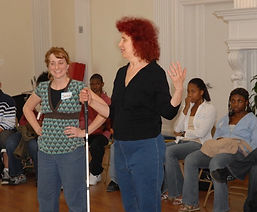
InSights 2006 Artist's Day, LightHouse for the Blind and Visually Impaired, San Francisco, September 2006. Barbara Romain, centre left in turquoise, facilitated the session. Estate of Barbara Romain archive.
Teaching.
Talks and curatorial.
2020
Women in Art · ARTH 341
Syllabus, lectures and projects in her own authorship · Columbia College Hollywood
Estate archive - on request
2006–07
Teaching Artist Fellowship
VSA arts, an affiliate of the John F. Kennedy Center · one of six Fellows nationally
Estate archive - on request
2003
Instructor, Art Institute of California – Los Angeles
Color theory · Santa Monica
Estate archive - on request
1999–2005
Instructor, AHCOP Program
Charles R. Drew University, Los Angeles
Estate archive - on request
1992–2023
Professor, Columbia College Hollywood
Art history, color theory and studio art, Tarzana. Named Outstanding Teacher of the Year in 2007. She taught until the end of her life; her last class met in 2023.
Estate archive - on request
1986–91
Associate Director of Education
Los Angeles Theatre Center · Theatre as a Learning Tool program
Estate archive - on request
2013
“Believing Is Seeing” · symposium talk and student workshop
Kunsthochschule für Medien, Cologne · May 28, 2013
Estate archive - on request
2007
CORE: Defining Ourselves · curator
National juried exhibition · Second City Council Gallery, Long Beach
Estate archive - on request
2006
InSights 2006 Artist’s Day · facilitator
LightHouse for the Blind and Visually Impaired, San Francisco
Estate archive - on request
2006
“Arts Based Learning”
VSA National Arts & Education Institute, Stevenson, Washington · and the VSA arts Conference for Affiliates, Washington, D.C.
Estate archive - on request
2003–04
“Let X = Education”
An Art Options seminar series, Los Angeles
Estate archive - on request
2002
California Arts Council Biennial Conference
Asilomar
Estate archive - on request
ART OPTIONS
No one is invisible.
In 1992, Barbara Romain and writer and educator Mira-Lani Bernard co-founded Art Options, an interdisciplinary arts education program built around a different premise: young people whom conventional institutions had already defined by their problems still possessed creative intelligence worth taking seriously.
The program began at the Museum of African American Art, working with teenagers from alternative high schools and programs, and expanded to serve young children, seniors, and other underserved communities at sites across Los Angeles, including the Los Angeles Theatre Center and La Casa. Barbara directed Art Options through 2007. Over fifteen years, it produced anthologies, exhibitions, theater productions and hundreds of workshops.
Painting, writing and performance were not treated as enrichment around the edges. They became ways to think, speak, collaborate and take creative responsibility. Art Options described its philosophy simply: “No one is invisible.”
The program held a California Arts Council Artist in Residence award for three years and became the vehicle for much of Barbara’s participatory public work, including the large-scale mural at La Casa, ceramic-tile projects along Sunset Boulevard, both editions of What’s in a Name?, and the seminar series developed through the program.
Barbara’s own studio practices moved into the classroom, and influence moved in the other direction as well. “Much of my inspiration has been derived over the years from my students,” she wrote.

STUDENT WORK

LA CASA

WHAT'S IN A NAME
VSA ARTS TEACHING FELLOWSHIP

SIGNS OF LIFE
