
IN MEMORIUM
Barbara Romain
1948–2024
She painted to music and wrote into her canvases, and when an accident happened, she let it stay.
By Meghan Romain, Estate Custodian
Barbara Romain beneath Hope & Loss, Satsuma Gallery, North Hollywood, August 2007. Archival photograph, Estate of Barbara Romain.
Someone Saw It Early · Hollywood, Justin, and a House Full of Paintings · When Seeing Changed · Chris, Shelley, and a Life Among Artists · The Work Kept Opening · Remembering Barbara · What Barbara Left Us
Barbara Romain died in Los Angeles on January 3, 2024, surrounded by family and friends, including her brothers, Jeffery and Elliott Levin, and her only son, Justin Romain. She is also survived by her niece, Cara Levin, and three grandchildren.
Losing her was devastating. For a long time, it was easier to care for the paintings than to explain the absence of the person who had made them. So that is where we began.
We opened boxes. We unrolled canvases. We explored old hard drives. We read artist statements, grant applications, letters and half-forgotten interviews. We called people who had known Barbara when she was young, when she was wild, when she was a mother, when she was losing her sight, when she was making theater, teaching teenagers, painting through the night, or simply holding court around a dinner table. Her son, Justin, began asking the questions a son does not always know to ask while his mother is still alive. Friends answered with stories. Family members corrected one another. A photograph would turn up and change a date. A cassette would return her voice to the room.
Somewhere in that process, the work of preserving Barbara’s archive also became a way of grieving her. We were not only cataloguing a career. We were rebuilding a life large enough to recognize the woman we had lost.
And slowly, Barbara became closer to us rather than farther away. This announcement has grown out of that work.
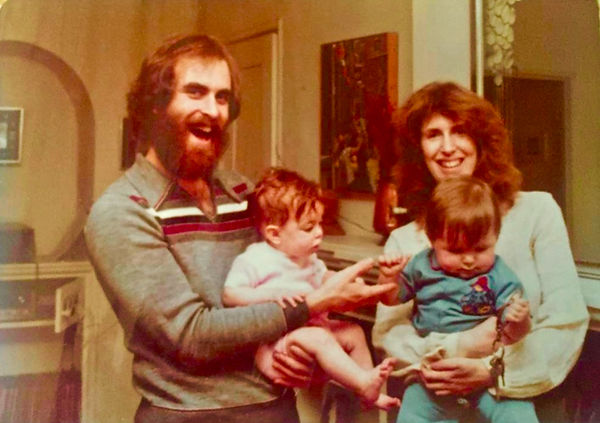
Barbara Romain and her brother Jeffery Levin, 1979 — Barbara holding her son, Justin, about a year old; Jeff holding his daughter, Cara. Family photograph, Estate of Barbara Romain.
SOMEONE SAW IT EARLY
Barbara was born Barbara Jo Levin and raised in West Philadelphia. Her father, Leon Lewis Levin, was an architect, and when she was little he sometimes brought her into his architecture-school classroom and studio, where she played with paints and drawing materials. As a child she took long Saturday bus rides to the Fleisher Art Institute and remembered having one of her first paintings, a large painting of three brightly colored horses, being chosen for its annual exhibition.
At Overbrook High School she found an art teacher, Mrs. Schroat, whom Barbara remembered for the rest of her life. She called her "a wonderful teacher" who "really encouraged" her and other students to pursue art seriously. Mrs. Schroat helped them apply for scholarships to Philadelphia art schools. Barbara won a four-year scholarship to the Philadelphia College of Art.
Looking back decades later, Barbara remembered the moment with characteristic understatement: "I was lucky enough to get one, so that's when I sort of officially kind of identified as an artist."
Barbara came out of art school in the 1960s with, as she put it, “absolutely no idea about making a living.” She traveled, lived on very little, hitchhiked, took small jobs, sold encyclopedias door to door and kept painting. Eventually she came west.
Los Angeles dazzled her. "Coming from gray Philadelphia," she said, "you are dazzled by the light of Los Angeles. It's got a special golden glow." She moved there in 1972. It would remain her city for the rest of her life.

Barbara Romain, 1983. Family photograph, Estate of Barbara Romain.
HOLLYWOOD, JUSTIN, AND A HOUSE FULL OF PAINTINGS
Barbara’s early Los Angeles years belonged to Hollywood: clubs, music, friendship, fashion, cheap apartments, long nights and the strange collisions that happen when young people are trying to invent their lives before they know what those lives will become.
Her best friend of fifty years, Shelley Sachs, remembered a circle of people drawn together by “music and art and all the other things that we all liked.” When Shelley first met Barbara, she thought she was so colorful and interesting that she simply wanted to know her.
Barbara met Alan Romain in the parking lot of the Rainbow on Sunset Boulevard in the early 1970s. Alan had come out of London's club and fashion world. His life was steeped in music, musicians, nightlife, style, and theater. He was not an artist himself, but he lived close to the cultural electricity of that era, and Barbara stepped into that world with him.
Alan remembers Barbara then as glamorous, daring, outgoing, courageous, exciting, and tremendous fun. But some of the memories that have stayed with us are quieter. He remembers her always painting at the dining-room table. The table was her easel. Paintings were stacked around the home and hanging on the walls. He remembers the smell of oil paint filling the rooms. Barbara took photographs and turned them into paintings.
They married in 1975. Barbara drew their wedding and painted Alan again and again over the years - at a diner, on the beach, by the pool. Together they had Barbara's only child, Justin. Barbara kept motherhood inside her own understanding of herself. In a 2009 narration, she described her interest in “my Hollywood friends, neighborhood and my life as a woman, mother, and worker.” In a 2007 interview, when asked to show an earlier work, she chose Stuart’s Pool, a picture of herself and her son, Justin.
Barbara and Alan eventually divorced. Looking back, she described the way women’s lives can become “sidetracked” from the straight career line people like to impose on artists. Then she immediately corrected the implication: she had been doing “a lot of really good painting at that time.” By her mid-thirties, she was living on her own as a single mom, and she was still painting.
Her sight, however, was changing.
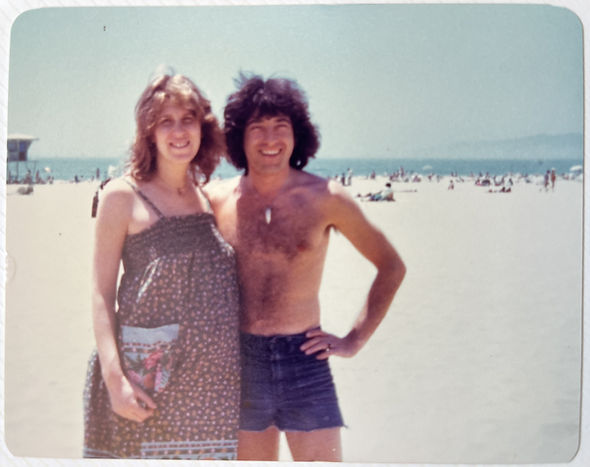
Barbara Romain pregnant with Alan Romain, 1978. Family photograph, Estate of Barbara Romain.
WHEN SEEING CHANGED
Barbara's sight had been complicated since childhood. At six, after measles, she went almost completely blind for several months before much of her vision returned. Decades later, as her first marriage was ending and she was beginning to claim her identity as an artist more fully, her sight began to diminish again.
At first, she hid it.
"At first I was in the closet, to tell you the truth, about my disability," she said years later. Her friends did not necessarily know. Shelley remembers being shocked when Barbara finally told her; she had never thought of Barbara as someone moving through the world with a limitation. Alan remembers the paintings continuing to accumulate around their home during the years when Barbara herself had not fully acknowledged what was changing.
In 1984, Barbara was diagnosed with a retinal degenerative disease and was legally blind thereafter. But she was careful about the order of the sentence. She had been a painter first.
"I was a painter prior to my vision loss," she wrote, "and have had to reinvent my process of working since."
That reinvention became one of the great continuities of her life. She worked larger and closer. Her colors intensified. She developed stencils for forms she could no longer reliably draw freehand. Music, memory and language assumed greater authority. She called part of what emerged "visual music."
Barbara never wanted blindness to become a tidy explanation for the work. "I always want the emphasis to be again on the artist first and the blind person next," she said.
What matters to us now is not that she "overcame" blindness. It is that she kept asking what else painting could become.

Barbara Romain, Pool Shark, 1986. Acrylic, oil and mixed media on canvas, 48 × 72 in. Queens of the Night collection. © Estate of Barbara Romain.
CHRIS, SHELLEY, AND A LIFE AMONG ARTISTS
After her divorce, Barbara met the writer C. Natale "Chris" Peditto. The way Barbara spoke about him tells us what he meant to her better than we ever could. She said Chris was "a big influence in my identifying myself strongly as an artist and understanding what that meant" - in surrounding herself more fully with an artistic community and making that life a central focus.
Through Chris came the Los Angeles Theatre Center, poets' theater, performance, and another way of making art that did not depend so heavily on sight. Barbara began writing monologues, producing, and performing. She worked in the Education Department. “That kind of opened some doors for me,” she said. She returned to graduate school at nearly forty, encouraged in part by watching Chris finish graduate school in his own forties. They married in the summer of 1995.
Their life together crossed writing, theater, poetry, music, and painting. Chris's words entered Barbara's canvases. Barbara's paintings entered their shared life. Years later, after his death in 2013, she made Requiem while thinking about death - but, she said, she wanted "some positivity to it." At the top she put a small pink butterfly.
Shelley Sachs belonged to this wider artistic family too. She and Barbara shared fifty years of friendship, performance, laughter and history. In 2026, while helping us remember, Shelley told Justin that she still dreams about Barbara - that they are hanging out again, laughing and moving through their old adventures, "like she never left, because she's so much in my heart."
Justin and I understand that feeling.

Barbara Romain with the writer C. Natale "Chris" Peditto, her husband and collaborator in Gray Pony, Los Angeles, 1988. Family photograph, Estate of Barbara Romain.
THE WORK KEPT OPENING
Barbara painted, performed, wrote, taught, made ceramics and public work, collaborated with poets and musicians, and spent thirty-two years teaching at Columbia College Hollywood. With Mira-Lani Bernard, she co-founded Art Options, an interdisciplinary arts program built around a belief in what they called the "natural brilliance of outsiders."
Her work traveled farther than we understood while she was alive. It appeared in museums, universities, galleries, and public spaces across the United States and internationally. She was the sole United States artist in ART BLIND in Cologne in 2013. Two of her paintings have continued traveling with Speaking Volumes: Transforming Hate for eighteen years and counting.
And yet this is where we want to resist telling the whole story.
Because one of the strangest parts of these last two years has been realizing how much none of us knew.
We have found works Justin had never seen. We have found unfinished works and evidence of directions Barbara explored privately and never folded into the public version of her career. We have opened boxes and files that suggest whole rooms of her creative life still waiting to be understood.
We are deliberately not cataloguing those discoveries here.
Some things belong first to the archive. Some may belong to future exhibitions, scholarship, performances, publications, or forms we have not imagined yet. Part of caring for Barbara's legacy, we are learning, is knowing when to tell a story and when to leave a door closed a little longer.

Barbara with Jeff and Elise Rogers, Shelley Sachs, and Summer Reese at MorYork Gallery, March 20, 2022 — the opening of I Am the Light and the Darkness, the last in-person exhibition on the estate's record
REMEMBERING BARBARA
The year after Barbara died, family and friends gathered at the Women's Twentieth Century Club of Eagle Rock for a celebration of her life. Her paintings filled the room. Her brother Elliott Levin performed with other jazz musicians, including Don Preston of the Mothers of Invention. Friends and poets read and spoke. So were people whose lives had crossed Barbara's through poetry, theater, music, art and decades of friendship.
Then everyone went back to Barbara's Echo Park home.
The conversation continued late into the night among the paintings. Stories were retold. Details contradicted one another. People laughed. People missed her. The rooms that had held Barbara's life began holding the memory of it instead.
That evening has stayed with us because it felt more truthful than any neat summation could. Barbara's life was never one medium, one community or one story. It accumulated.
"My work, even when confronting sad or serious themes, I hope reflects a sense of life and joy in the face of sorrow." Barbara Romain, REMEMBER, OCCCA, 2018
We think that sentence belongs here too.

Bonnie Barnett speaking at the Celebration of Life for Barbara Romain, 2025. At the Women's Twentieth Century Club of Eagle Rock.
WHAT BARBARA LEFT US
When Barbara passed, Justin and I did not inherit a tidy archive with a finished history attached to it. We inherited his mother's life’s work.
For more than two years, we have lived inside it.
We have catalogued paintings and ceramics, opened boxes she packed years ago, recovered old files, listened to recordings, read her words, called the people who knew her, and tried to reconnect objects with the lives around them. Justin has had the strange and sometimes painful experience of meeting parts of his mother for the first time after losing her.
I have watched my husband grieve his mother by trying to understand her.
And somewhere along the way, preserving Barbara's work became part of mourning Barbara.
We know now that this will not be the last story we tell about her. It should not be. There is too much still unfolding, and we want to leave room for future curators, scholars, collaborators, artists and audiences to encounter things we ourselves are only beginning to understand.
What we can do now is begin opening the work outward.
LOS ANGELES · TUESDAY FEBRUARY 9, 2027, 4PM - 8PM
The Echo Park home and studio
For the first time, Barbara's family will open her longtime Los Angeles home and modified studio to the public. The evening follows more than two years of cataloguing hundreds of paintings and ceramics, rebuilding exhibition histories, and recovering material that had not been seen or read in decades.
This is a rare opportunity to encounter the work in the place where Barbara lived and worked.
4 to 5 PM private preview for press and curators, by invitation · 5 to 8 PM open to everyone
430+
documented paintings
100+
ceramics
45
works coming into view
2027
first public opening of the home & studio
Press and curators: write to us for an invitation to the 4 PM preview.
After two years spent going inward - into her rooms, her papers, her paintings, other people's memories and our own grief - it feels right that the next movement should be outward.
Not everything will be told.
But the doors will open.
Barbara once described the creative impulse as something almost addictive. Once you get "hooked on that creative juice," she said, "there's nothing like it."
Then she said it more simply: “I feel like it is my life’s work.”
We are doing our best to care for it - and, finally, to share it.